

Archived article · Original source date: 2024-08-31
This article is preserved from the previous Solana Bulls site as a historical archive. It reflects its original context; references to products, people, market conditions, eligibility, or rules may no longer be current.
This blog post explores the foundations of integrating Solana with AI, unlocking industry potential, and navigating adoption challenges. We'll examine the advantages of Solana in AI development, current use cases, and future possibilities of AI-driven decentralized applications (dApps).
Providing strategies for seamless integration will be a key focus, allowing developers to unlock the full potential of this powerful combination.
Foundations of Integration: Blockchain Meets AI
Blockchain Limitations in AI Development: Understanding the Landscape
Despite its potential, blockchain technology presents limitations in AI development, including scalability issues, high computational costs, and inherent latency in transactions.
These challenges can hinder AI applications requiring rapid data processing and real-time decision-making.
Scalability's Role in Integrating Solana with Artificial Intelligence
Solana's fast and scalable blockchain platform addresses the limitations of traditional systems, providing a solid foundation for AI development.
This enables high transaction throughput and low latency, supporting AI models that rely on real-time data processing and analysis.
Smart Contract Interoperability and AI Model Deployment Strategies
Smart contract interoperability is critical in integrating AI models with blockchain technology.
Projects like Nosana and Kuzco enable the deployment of AI inference workloads on decentralized GPU grids, making massive compute power accessible while reducing computational costs.
Unlocking Industry Potential: Solana and AI Convergence
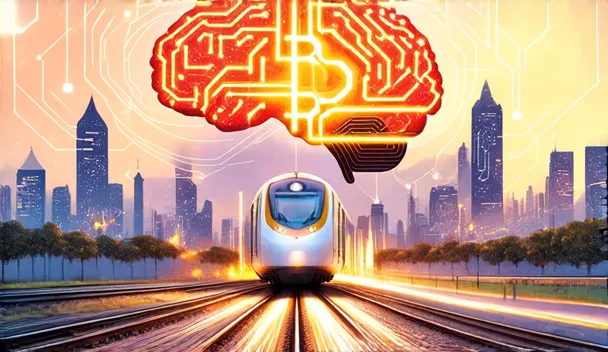
Enhancing AI Development on Blockchain: The Solana Advantage
The convergence of Solana and artificial intelligence (AI) offers a compelling value proposition for developers and businesses seeking to unlock new potential in AI-driven applications.
By leveraging Solana's fast and scalable blockchain platform, AI projects can overcome traditional limitations such as high computational costs, data processing inefficiencies, and latency issues.
Accelerating Decentralized Applications with AI-Driven Solutions on Solana
Platforms like Nosana are pioneering the use of decentralized GPU grids to support AI inference workloads, enabling faster processing times and reduced computational costs.
Meanwhile, Helius is providing developer tools that streamline the process of building on Solana, making it easier for developers to integrate AI models into their dApps.
Unlocking Business Opportunities through Solana-AI Synergy
The integration of Solana and artificial intelligence unlocks a wide array of business opportunities across various industries.
Companies like Nosana are pioneering decentralized GPU grids optimized for AI inference workloads, enabling individuals and organizations to monetize idle GPU power while providing scalable and efficient solutions for AI projects.
Solana's Advantages in AI Development: Speed, Scalability, Security, and Beyond

Solana's Fast and Scalable Blockchain for AI Development
The integration of Solana and artificial intelligence (AI) relies heavily on scalability, enabling efficient processing of vast amounts of data required for AI-driven applications.
Solana's blockchain platform provides high transaction throughput and low latency, making it ideal for AI models that rely on real-time data analysis.
Security Features Protecting AI-Driven Applications
To safeguard AI-driven applications against threats, Solana's blockchain platform offers robust security features.
The Proof-of-History (PoH) ordering clock provides decentralization and makes it difficult for malicious actors to manipulate transaction order or data.
Additionally, seamless integration with decentralized oracles allows AI applications to access off-chain data while maintaining on-chain computation benefits.
Real-World Applications of Solana-Powered AI
Notable examples of Solana-powered AI include the deployment of decentralized GPU grids optimized for AI inference workloads.
Platforms like Nosana and Kuzco enable individuals to monetize idle GPU power while providing scalable solutions for AI projects.
By leveraging Solana's fast blockchain, these initiatives overcome traditional limitations such as high computational costs and latency issues.
AI-Driven dApps on the Solana Ecosystem: Current State, Use Cases, and Future Possibilities

The Current State of AI-Driven dApps on the Solana Blockchain
The current state of AI-driven decentralized applications (dApps) on the Solana blockchain is characterized by rapid innovation and growth.
Projects like Nosana and Kuzco are pioneering decentralized GPU grids optimized for AI inference workloads, enabling scalable and efficient solutions for AI projects while providing cost-effective alternatives to traditional cloud services.
Use Cases of Artificial Intelligence in the Solana Ecosystem
Notable examples of real-world applications include Nosana and Kuzco's decentralized GPU grids optimized for AI inference workloads.
These platforms enable individuals and organizations to monetize idle GPU power while overcoming traditional limitations such as high computational costs, data processing inefficiencies, and latency issues.
Future Possibilities: Integrating AI with Solana's Scalable Infrastructure
The integration of artificial intelligence (AI) and Solana's scalable infrastructure holds immense potential for future innovations.
As the demand for more efficient, secure, and cost-effective solutions continues to grow, Solana's fast and scalable blockchain platform is poised to play a pivotal role in unlocking new business opportunities across various industries.
Navigating Integration Challenges: Strategies for Seamless Solana-AI Adoption

Overcoming Technical Barriers in Solana-AI Integration
To overcome technical barriers in integrating Solana and artificial intelligence (AI), several challenges must be addressed.
One major obstacle is optimizing AI inference workloads for decentralized environments, which often require complex model architectures and high computational power.
Initiatives like Nosana have emerged to provide a decentralized GPU grid optimized for AI inference workloads on the Solana blockchain.
Mitigating Security Risks in AI-Driven Blockchain Applications
Ensuring the security of AI-driven applications on blockchain platforms like Solana is crucial. Understanding potential vulnerabilities arising from integrating AI models with blockchain technology is key to mitigating risks.
For instance, decentralized oracles can introduce new attack vectors if not properly secured. Solana's blockchain architecture allows for seamless integration with decentralized oracles, enabling AI applications to access off-chain data while maintaining the security benefits of on-chain computation.
Balancing Scalability and Efficiency in Solana-Powered AI Solutions
Integrating Solana's fast and scalable blockchain platform with artificial intelligence (AI) requires balancing scalability and efficiency.
As AI-driven applications push boundaries, it's essential to ensure the underlying infrastructure supports their computationally intensive nature without sacrificing performance or security.
Solana's features offer a robust foundation for safeguarding these applications against threats while maintaining high transaction throughput and low latency.
Conclusion
The intersection of Solana and artificial intelligence has profound implications for various industries, including finance and healthcare.
By grasping the fundamentals of blockchain-AI integration, we can unlock industry potential through their convergence. Solana's unique advantages - speed, scalability, security, and more - make it an ideal platform for developing AI-driven decentralized applications (dApps).
As the Solana ecosystem evolves, addressing integration challenges will be crucial. This may involve overcoming technical barriers, mitigating security risks, and striking a balance between scalability and efficiency.
The future of Solana-AI synergy is promising, with potential applications in areas such as predictive analytics for optimized resource allocation, natural language processing for enhanced user experiences, and more.
As the landscape unfolds, the convergence of these two technologies will likely drive innovation and solve real-world problems.