

Archived article · Original source date: 2024-08-14
This article is preserved from the previous Solana Bulls site as a historical archive. It reflects its original context; references to products, people, market conditions, eligibility, or rules may no longer be current.
The realm of gaming has long been fascinated by the prospects of space exploration and strategy, with many titles attempting to capture the essence of navigating the cosmos.
As blockchain technology continues to reshape the landscape of digital assets and ownership, a new player emerges in the form of Star Atlas, a revolutionary gaming experience that seamlessly integrates immersive gameplay with the security and transparency of blockchain-based assets.
Discovering Star Atlas: A Revolutionary Gaming Experience
Introduction to Star Atlas: A New Era in Gaming
Imagine a virtual universe where you can explore, strategize, and conquer as part of an immersive gaming experience.
Welcome to Star Atlas, a revolutionary blockchain-based game that's set to redefine the boundaries of interactive entertainment. This groundbreaking platform combines stunning visuals with cutting-edge technology, allowing players to engage in a vast, space-themed ecosystem like never before.
By leveraging the power of blockchain, Star Atlas ensures a transparent, secure, and community-driven experience that's as unique as it is captivating.
As we delve deeper into the world of Star Atlas, you'll discover how this innovative game is poised to change the gaming landscape forever.
Understanding the Gameplay Mechanics and Core Concept
At its core, Star Atlas is a massively multiplayer online (MMO) game that leverages blockchain technology to create a unique gaming experience.
The gameplay mechanics are centered around space exploration, territory ownership, and strategic resource management. Imagine a galactic version of Monopoly, where players navigate through a vast, procedurally generated universe, colonize planets, and build infrastructure to generate resources.
However, unlike traditional games, Star Atlas incorporates blockchain-powered non-fungible tokens (NFTs) that represent in-game assets, such as spaceships, land claims, and equipment. This allows for true ownership and scarcity of digital assets, enabling players to buy, sell, and trade them on open marketplaces.
The Future of Gaming with Blockchain-Based Assets
Imagine a gaming world where in-game assets are more than just digital trinkets - they're tangible, unique, and owned by you.
This is the promise of Star Atlas, a revolutionary gaming experience that leverages blockchain technology to redefine the relationship between gamers and their digital possessions.
By utilizing non-fungible tokens (NFTs), Star Atlas creates a new paradigm where in-game assets are stored on a decentralized ledger, ensuring their scarcity, provenance, and permanence.
This concept is analogous to owning a rare collectible or a unique piece of art - the value lies not only in its aesthetic appeal but also in its authenticity and ownership.
With blockchain-based assets, Star Atlas unlocks new possibilities for gamers to engage with, trade, and build upon their digital treasures.
Gameplay Fundamentals: Core Concept and Mechanics

Core Concept: Space Exploration and Strategy
In Star Atlas, space exploration is woven into the fabric of gameplay, where strategy meets discovery. Players are tasked with navigating a vast galaxy, uncovering hidden opportunities and confronting unforeseen challenges.
The core concept revolves around expanding one's interstellar empire by exploring new planets, moons, asteroids, and other celestial bodies. This process involves scouting for resources, identifying potential allies or adversaries, and plotting the optimal course of action to maximize returns while minimizing risks.
Drawing parallels with traditional strategy games like Risk or Catan, Star Atlas demands players think several moves ahead, weighing the benefits of exploration against the costs of expansion - all while adapting to an ever-changing galaxy.
Gameplay Mechanics: Navigating the Galactic Map
Navigating the vast expanse of space in Star Atlas requires a keen understanding of its galactic map. This dynamic, interactive map serves as the foundation for gameplay, allowing players to explore, discover, and interact with various celestial bodies, factions, and resources.
Imagine a 3D representation of a classic Risk board, where each sector is home to unique challenges, opportunities, and mysteries waiting to be uncovered. As players navigate this map, they'll encounter diverse planetary environments, asteroid fields, black holes, and wormholes - each presenting its own set of risks and rewards.
Asset Management: Acquiring and Utilizing In-Game Resources
In Star Atlas, asset management is a crucial aspect of gameplay. Players must acquire and utilize in-game resources effectively to progress through the game.
This involves collecting and managing assets such as ships, crew members, equipment, and other valuable commodities. Think of it like managing a virtual fleet, where each asset has its own strengths and weaknesses.
For instance, acquiring a high-quality ship can significantly improve your chances of winning space battles, while hiring skilled crew members can increase resource gathering efficiency.
As players navigate the game's vast galaxy, they'll need to continually assess their assets, upgrade or discard them as needed, and make strategic decisions about how to allocate resources to achieve their goals.
Immersive Gameplay Features: Exploration, Empire Building, and Strategic Depth
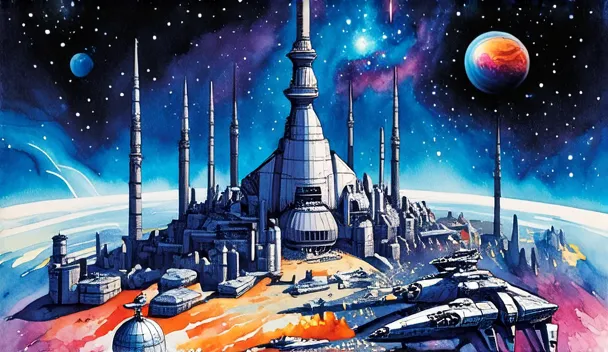
Building a Galactic Empire: A Deep Dive
In Star Atlas, building a galactic empire is an immersive and complex experience that combines exploration, strategy, and role-playing elements.
Players can establish their own unique presence in the galaxy by colonizing planets, constructing infrastructure, and recruiting NPCs (non-player characters) to aid in their quest for dominance.
This process is similar to building a business or managing a city, where players must balance resource production, allocate budget, and make key decisions that impact the growth and prosperity of their empire.
Managing Resources, Assets, and Strategic Decision-Making
In Star Atlas, effective resource management is crucial to building a thriving empire. Players must balance their resource allocation across various assets such as ships, structures, and personnel.
Think of it like managing a complex economy, where every decision has a ripple effect on your overall strategy. For instance, allocating resources to build a new ship might mean diverting funds from upgrading existing vessels or hiring skilled crew members.
The game demands strategic thinking, forcing players to prioritize their goals and make tough decisions that will ultimately determine the fate of their empire.
Balancing Growth and Risk in Star Atlas
In Star Atlas, growth and risk are intertwined like the threads of a rich tapestry. As you expand your empire, you'll need to balance the thrill of exploration with the threat of unknown dangers.
It's akin to investing in stocks - every venture has potential for return, but also comes with inherent risks.
In this universe, the risk of encountering hostile aliens or rival factions can be mitigated by strategic planning and resource allocation. For instance, investing in advanced scouting technologies can provide crucial intel on uncharted territories, helping you make informed decisions about where to expand next.
Conversely, over-extending your empire's boundaries without adequate support can leave you vulnerable to attacks from all sides.
Blockchain Integration and Asset Management: Ownership, Monetization, and Tokenomics
Blockchain Integration: Enhanced Asset Ownership and Security
By integrating blockchain technology, Star Atlas enables secure, transparent, and tamper-evident ownership of in-game assets.
This decentralized approach ensures that players have full control over their digital possessions, eliminating the risk of centralized authorities manipulating or confiscating their assets.
Think of it as having a deed to a house, where the blockchain serves as a public ledger, verifying ownership and protecting against potential disputes.
In Star Atlas, this concept applies to spaceships, real estate, and other virtual assets, providing an unprecedented level of security and autonomy for players.
Monetizing In-Game Assets through Decentralized Marketplaces
In Star Atlas, players can monetize their in-game assets by buying, selling, and trading them on decentralized marketplaces. This empowers a player-driven economy where ownership and value are determined by the community.
Imagine owning a rare spaceship or a valuable plot of land - with blockchain technology, these digital assets can be securely stored, verified, and transferred without intermediaries.
Decentralized marketplaces allow for peer-to-peer transactions, reducing reliance on centralized authorities and enabling new opportunities for creators to earn revenue from their unique in-game items.
Tokenomics: Supply, Distribution, and Value Proposition
The tokenomics of Star Atlas are designed to create a self-sustaining economy that rewards players and contributors. The total supply of tokens is capped at 170 million, with a distribution plan that allocates a significant portion to the community through staking, governance, and in-game activities.
This approach ensures that the value proposition is aligned with the interests of the ecosystem participants. Think of it like a decentralized, blockchain-based stock market, where players can buy, sell, and trade assets, such as spaceships and equipment, based on their perceived value.
The tokenomics model incentivizes collaboration, strategic trading, and long-term investment, creating a robust and dynamic economy that simulates real-world market forces.
Technical Foundation: Solana Blockchain*, Scalability, and Performance Optimization

Technical Overview: Solana Blockchain* and Scalability Solutions
The Star Atlas ecosystem is built on the Solana blockchain, a fast and scalable platform that enables high-performance applications.
Solana combines proof-of-stake validators and Tower BFT consensus with Proof of History as a verifiable clock for ordering events.
This means that Star Atlas can support complex, real-time interactions without sacrificing performance or security.
Imagine a highway system where all lanes are always available, eliminating congestion and allowing cars to move at optimal speed - Solana's architecture achieves similar efficiency in blockchain transactions.
Performance Optimization Techniques for Seamless Gameplay
To ensure a seamless gaming experience in Star Atlas, performance optimization techniques are crucial.
One technique is parallel processing, where multiple tasks are executed simultaneously to reduce lag and increase responsiveness. This is similar to how a multi-core processor handles multiple applications at once, allowing the game to render graphics, handle user input, and update the game state concurrently.
Another technique is data caching, which stores frequently accessed data in memory for faster retrieval, much like how web browsers cache frequently visited websites to reduce loading times.
By leveraging these techniques, Star Atlas can achieve a high level of performance optimization, resulting in fast rendering, smooth gameplay, and an immersive overall experience.
Ensuring a Smooth Gaming Experience in Star Atlas
To deliver an immersive and seamless gaming experience, Star Atlas relies on Solana's blockchain technology to optimize performance and scalability. This strategic choice enables the game to handle large volumes of concurrent transactions, ensuring that players can engage with the virtual universe without interruptions or lags.
Think of it like a high-performance sports car: just as a well-tuned engine allows for smooth acceleration and responsive handling, Solana's blockchain architecture empowers Star Atlas to deliver a similarly smooth and immersive gaming experience.
Conclusion
In this in-depth exploration of Star Atlas, we have uncovered the revolutionary gaming experience that awaits players in this blockchain-integrated game. From its core concept and gameplay mechanics to immersive features and strategic depth, Star Atlas offers a unique blend of space exploration and strategy.
We've examined how blockchain technology enhances asset ownership and security, enabling monetization through decentralized marketplaces and a well-designed tokenomics system. The technical foundation of Solana Blockchain ensures scalability and performance optimization for seamless gameplay.
As the gaming landscape continues to evolve, Star Atlas stands out as a pioneer in the convergence of gaming and blockchain. With its innovative approach, Star Atlas is poised to redefine the gaming experience, offering players unparalleled ownership, strategy, and excitement.