

Archived article · Original source date: 2024-08-31
This article is preserved from the previous Solana Bulls site as a historical archive. It reflects its original context; references to products, people, market conditions, eligibility, or rules may no longer be current.
Blockchain technology emerges as a key enabler of secure, scalable, and transparent decentralized AI marketplaces, offering unprecedented opportunities for innovation and collaboration.
Unlocking the Potential of Decentralized AI Marketplaces
Limitations of Centralized AI Platforms
Centralized AI platforms have inherent limitations that hinder the full realization of AI's potential.
Data ownership and control are major concerns, as data is often siloed within a single entity, limiting accessibility and collaboration opportunities among developers and researchers.
Scalability issues also arise when increased demand for computational resources leads to bottlenecks and inefficiencies.
Envisioning a Decentralized AI Future on Solana
The decentralized AI future is about creating an ecosystem where innovation thrives through collaboration and open access.
Pioneers like Nosana, Kuzco, Helius, Solflare, and Render Network are leveraging the Solana blockchain to redefine AI development and deployment by decentralizing GPU resources, facilitating cost-effective LLM inference, providing robust developer tools, secure non-custodial wallets, and pioneering decentralized graphics processing unit computing.
Exploring Decentralized AI Marketplace Functionality on Solana

Decentralized AI Marketplace Architecture and Design
A well-designed decentralized AI marketplace architecture is crucial for scalability, security, and efficiency.
Solana-based projects like Nosana and Kuzco pioneer this vision with decentralized GPU grids and distributed clusters optimized for AI inference workloads and large language model processing.
Benefits of Decentralizing AI Services on Solana
Decentralizing AI services on Solana offers numerous benefits, including scalability, cost-effectiveness, and transparency.
This approach democratizes access to AI technologies and fosters a collaborative ecosystem where developers and researchers can share resources and knowledge without centralized gatekeepers.
Suitable AI Services for Decentralized Marketplaces
Nosana is leading the way with its decentralized GPU grid optimized for AI inference workloads, providing a cost-effective solution for individuals and businesses to scale their AI projects.
This service showcases how Solana-based decentralized marketplaces can cater to different aspects of AI development and deployment.
Blockchain's Role in Secure, Scalable, and Transparent Decentralized AI

Ensuring Data Protection and Integrity through Robust Security Measures
Public blockchains do not provide protocol-wide encryption, confidentiality, anonymity, or end-to-end communication security. Applications must separately minimize sensitive on-chain data and implement appropriate encryption, key management, access controls, transport security, retention, and privacy review.
These measures collectively protect sensitive information from unauthorized access, ensuring confidentiality and privacy in AI development and deployment.
Scalable Architectures for Efficient Decentralized AI Marketplaces
Solana-based projects like Nosana and Kuzco pioneer scalable architectures designed specifically for AI inference workloads and large language model processing.
By decentralizing GPU resources, they create environments where individuals and businesses can access computational power without being constrained by traditional cloud services.
Trustless AI Service Exchange through Transparent Transaction Mechanisms
Nosana's decentralized GPU grid and Kuzco's distributed cluster for LLM inference enable secure, transparent, and scalable transactions.
Nosana's tokenized system efficiently allocates computational resources based on market demand, while Kuzco's platform maintains user control over data and computational resources.
This fosters trust among participants and ensures secure, transparent transactions without intermediaries.
Decentralization Benefits: Data Ownership, Economic Opportunities, and Community Governance

A New Paradigm for AI Development and Ownership
The emergence of decentralized AI marketplaces on Solana signals a profound shift in how we approach artificial intelligence development and ownership.
By democratizing access to computational resources, innovators like Nosana and Kuzco are creating an environment where individuals and organizations can engage with AI technologies without the constraints of centralized gatekeepers.
Community Governance and Decision-Making
The success of decentralized AI marketplaces on Solana hinges on effective community governance and decision-making processes. This involves creating frameworks that allow stakeholders to participate actively in shaping the future of these ecosystems.
Nosana's decentralized GPU grid empowers users to contribute not only computational resources but also their insights and expertise towards optimizing the platform's performance and scalability.
Kuzco's distributed LLM inference approach encourages a collaborative environment where developers can share knowledge, best practices, and feedback to enhance the overall efficiency of the network.
Building Decentralized AI Marketplaces on Solana: Infrastructure and Tools
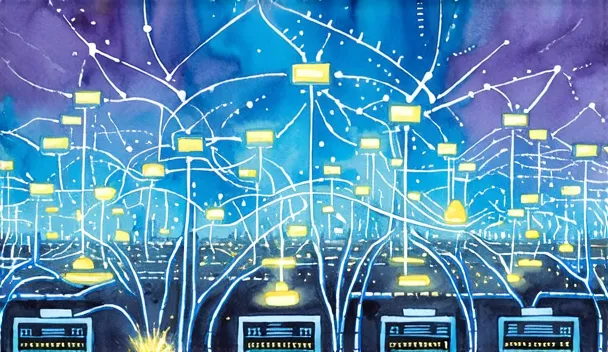
Solana's Infrastructure Requirements for Decentralized AI
Decentralized AI marketplaces on Solana require a robust infrastructure supporting scalable, secure, and transparent computational resources.
Key components include decentralized GPU grids, distributed clusters, and high-performance developer tools. Projects like Nosana and Kuzco are pioneering optimized architectures for AI inference workloads and large language model processing.
These innovations democratize access to massive compute power while promoting environmentally friendly options.
Scalability and Performance Considerations
To ensure seamless interactions between developers, data providers, and computational resource contributors, decentralized AI applications on Solana must carefully consider scalability and performance.
Scalability is critical, as it directly impacts the ability of these platforms to support growing demands without sacrificing efficiency or increasing costs.
Innovators are addressing this challenge by pioneering scalable architectures designed for AI inference workloads and large language model processing.
Necessary Tools and Technologies
Developers building decentralized AI marketplaces on Solana require specialized tools and technologies, such as Helius' comprehensive development tools, including high-performance Solana RPC nodes, Solana webhooks, APIs, and other developer tooling.
Additionally, Solflare offers a non-custodial wallet supporting essential functions like storing, sending, and receiving Solana tokens, as well as staking SOL and seamless interaction with decentralized applications (dApps) on the Solana network.
Overcoming Challenges in Decentralized AI Marketplaces

Scaling Decentralized AI Marketplaces on Solana
Innovators like Nosana and Kuzco are addressing scalability challenges by pioneering architectures designed for AI inference workloads and large language model processing.
These projects decentralize GPU resources, enabling cost-effective LLM inference and allowing individuals and businesses to access computational power without traditional cloud constraints.
Ensuring Security, Transparency, and Fairness
Additionally, projects like Nosana and Kuzco prioritize transparency and fairness by fostering open-source collaboration, community-driven development, and transparent data sourcing practices.
Conclusion
This article highlighted the potential of decentralized AI marketplaces on Solana's blockchain, enabling secure, scalable, and transparent services that promote data ownership, economic opportunities, and community governance.
By decentralizing AI services, users can access various models and algorithms while maintaining control over their data and decision-making processes.
As we move forward, it will be exciting to see how these marketplaces continue to evolve and provide innovative solutions for individuals and organizations.