

Archived article · Original source date: 2024-02-24
This article is preserved from the previous Solana Bulls site as a historical archive. It reflects its original context; references to products, people, market conditions, eligibility, or rules may no longer be current.
Blockchain technology, particularly within the Solana network, operates on a delicate balance of transaction fees, staking, and other economic mechanisms to ensure validator are incentivized to continue running the network. These incentives are crucial for maintaining network security and efficiency. However, with Solana's inflation rate trending towards 1.5%, the reliance on network inflation for validator profitability is increasingly challenged. This necessitates the exploration of alternative revenue streams to secure the until the base transaction fees generated through usage are large enough to cover the deficit.
How Validators Earn Revenues Today

Validators on the Solana network and similar blockchain platforms derive their revenues from several sources, with transaction fees, commission on staking rewards, MEV tips, and other validator bribes. being the primary contributors. Specifically, the validator that acts as the leader and successfully adds a block to the blockchain earns half of the base transaction fees and half of the priority fees from that block. These fees are awarded for processing and validating transactions, incentivizing the participation in network operations. However, it's important to note that the revenue generated from both base and priority transaction fees is currently relatively small when compared to staking rewards.
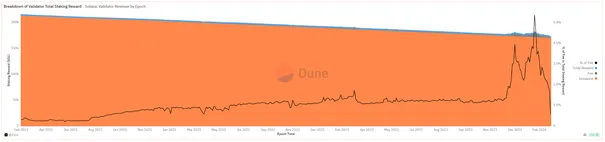
Staking rewards constitute a significant portion of validator revenue and are generated through network inflation. The inflation mechanism distributes new SOL tokens proportionally to validators based on the amount of SOL they have staked. Validators can stake their own SOL tokens and also accept delegations from other token holders, effectively increasing their stake and potential rewards. Each validator sets a commission rate, which is a percentage charged to delegators on the inflation rewards earned on their staked SOL. This commission model allows validators to earn a consistent income while contributing to the network's security and consensus mechanisms.
Understanding Maximal Extractable Value (MEV)

Maximal Extractable Value (MEV) refers to the maximum value validators can extract from transaction ordering within a block, beyond the standard block rewards and transaction fees. MEV arises from the ability of validators (or miners in other blockchains) to reorder, insert, or censor transactions within the blocks they produce. While often criticized, MEV will always exist in environments where significant value is transacted and can have positive use cases, such as improving liquidity on decentralized exchanges, reducing slippage in large trades, and enabling sophisticated trading strategies that can benefit the overall market efficiency. Validators can earn substantial tips from users or decentralized applications for successfully capturing MEV opportunities, providing an additional revenue stream that can significantly exceed the earnings from transaction fees and staking rewards in some scenarios.
Negative Externalities of MEV and Solana Priority Fees

The potential for validators to earn from MEV and priority fees introduces a complex dynamic that can conflict with the user experience. While MEV can offer positive contributions to market efficiency, its implementation can lead to adverse effects for regular users. For instance, the prioritization of transactions based on fees or the manipulation of transaction order for MEV can disadvantage users not participating in these practices, such as through delayed transaction processing or exposure to predatory trading tactics like front-running and sandwich attacks. These practices can extract value from ordinary transactions, leading to a sense of unfairness and a perception that the blockchain system favors wealthier participants or those with advanced trading setups. This reality contrasts with the blockchain ideal of a transparent, equitable, and efficient system, highlighting the need for careful consideration of how these economic mechanisms are structured and their impact on the broader user base.
The Ideal Future: Volume-Driven Profitability

To determine whether volume-driven profitability for Solana validators is possible, it's essential to delve deeper into the dynamics of transaction volume and its impact on the network's economic sustainability. Solana would need to experience a massive increase in transaction volumes, sufficient to render base fees alone as a stable source of income for validators. This scenario does not merely reflect an aspiration but is a strategic objective that underscores the scalability and efficiency inherent in blockchain technology, particularly within ecosystems like Solana.
In an ecosystem where transaction volumes on Solana reach or surpass those of major financial networks such as Visa, which processes tens of thousands of transactions per second, the implications for Solana are profound. High transaction volumes mean that even minimal base fees can accumulate into significant earnings for validators, ensuring their operational profitability without the need for high transaction fees or reliance on MEV practices that can detract from user experience.
This future is not as distant as it may seem. The emergence of blockchain-based applications, including decentralized finance (DeFi) platforms, non-fungible token (NFT) marketplaces, and blockchain gaming, hints at the potential for such expansive growth. For instance, blockchain games like Star Atlas demonstrate the capacity for a single application to generate substantial transaction volumes. If replicated across hundreds of applications, the combined transactional activity could dramatically shift the economic landscape for validators.
Moreover, the potential integration of blockchain technology into global payment systems, stock trading, and even novel applications in artificial intelligence and data verification presents untapped avenues for transaction volume growth. As these applications mature and gain wider acceptance, the Solana network could see an exponential increase in transactions, underpinning the economic model that sustains validator profitability through base fees alone.
In this envisioned future, the economic viability of validators becomes intrinsically linked to the network's success in driving transaction volume. This creates a virtuous cycle where increased activity not only benefits validators economically but also enhances the network's value proposition to users and developers, further accelerating adoption and growth.
Balancing Solana Validator Incentives

As Solana strides towards a future where base fees fuel validator profitability, the introduction of specialized "channels" emerges as a potential adaptation to the network's evolving economic landscape. This concept envisions a diversification of roles within the validator community, where smaller validators might carve out niches offering bespoke services that align with the nuanced demands of the ecosystem, such as transaction bundling for MEV (Maximal Extractable Value). Meanwhile, larger validators could continue to prioritize a first-come-first-serve approach in exchange for some other economic incentive, thereby preserving the integrity of user experience by ensuring equitable transaction processing times.
The decision for some validators to abstain from running MEV software, despite its widespread adoption across nearly 80% of the network, underscores a complex calculus of incentives. Validators weighing the potential gains from MEV against the broader implications for network health and user trust may opt out of MEV activities to maintain a focus on long-term ecosystem sustainability. This stance reflects a nuanced understanding of MEV's dual nature, where certain practices can either enhance or detract from the overall network value. By categorizing MEV activities into beneficial (such as arbitrage that enhances market efficiency) and detrimental (like front-running that can harm user trust) use cases, validators could implement a pricing model that incentivizes positive contributions to the network while discouraging exploitative behavior. This social contract among validators to prioritize the collective good over individual profit maximization could foster a more balanced and ethical MEV landscape.
The concept of managed validator services represents another avenue for validator revenue diversification, tapping into the deep reservoir of expertise accumulated by validators in the nascent stages of Solana's development. As the blockchain space matures, attracting more substantial entities like large businesses and financial institutions, the demand for personalized, trustworthy node operations escalates. These entities may recognize the value of operating a dedicated validator both as a source of verifiable truth and to ensure participation in the network's consensus mechanisms without compromising their core operations. For them, outsourcing validator management to seasoned professionals allows them to leverage the benefits of direct network participation—such as enhanced data integrity and transactional autonomy—while treating the operational aspects as a cost center. This approach not only opens up new revenue streams for validators but also deepens the network's institutional engagement, laying the groundwork for a more diverse and resilient blockchain ecosystem.
This gradual differentiation within the validator community, between those focusing on traditional validation and those innovating in MEV optimization and managed services, heralds a sophisticated economic model. It promises to sustain validator incentives through a blend of traditional fees, ethical MEV practices, and specialized services tailored to the evolving needs of Solana's diverse user base.
The Future of Solana Validators

As Solana's ecosystem matures the traditional role of for-profit validators faces potential reevaluation if transaction volume alone doesn’t ensure validator profitability. This transition, however, is not immediate but a distant prospect, contingent upon a future where cryptocurrency, and Solana specifically, gains massive mainstream adoption. Such a paradigm shift, where large corporations and financial institutions integrate blockchain deeply into their operations, could redefine validators' roles, transitioning them from profit-centric entities to operational cost centers. This evolution mirrors the current, singular example of Circle, the issuer of USDC, who runs a validator to ensure the integrity of its operations on Solana.
The premise of operating a validator for reasons beyond profit hinges on the guarantee of honesty and operational integrity it provides. By running their own node, a business can independently verify transactions and the state of the blockchain, ensuring their operations align with the network's truthful state. This autonomous verification acts as a safeguard against discrepancies or disputes within the network. If a validator's node ever diverges from the consensus of the network, the entity can halt operations, preventing the transfer of "real" value (such as U.S. dollars) until the discrepancy is resolved. This mechanism is critical for businesses where blockchain transactions have immediate real-world financial implications.
The types of businesses that might seek such guarantees span industries where the accuracy and integrity of transactional data are paramount. Financial institutions, for instance, require unwavering assurance in the execution and settlement of transactions to maintain trust and comply with regulatory standards. Similarly, large corporations that leverage blockchain for supply chain management, intellectual property rights management, or even in decentralized autonomous organizations (DAOs) for governance, could find the honesty guarantee provided by running their own validator invaluable. These entities might be willing to absorb the operational costs associated with validator management as a strategic investment in securing their blockchain-based transactions and data integrity.
This "prospective" future, where entities operate validators as cost centers rather than for direct profitability, underscores a nuanced evolution of the blockchain's economic and operational paradigms. While at first glance, this shift might seem to dilute the principle of decentralization, it paradoxically could enhance it by broadening the validator base across a diverse array of longer-term stakeholders. This long-term vision, albeit years away, points to a sophisticated blending of blockchain technology into the fabric of global finance and corporate operations, heralding a new era of digital trust and transactional efficiency.
Conclusion
The exploration of Solana's economic mechanisms highlights the complex interplay between ensuring network security, sustaining validator profitability, and providing a user-friendly experience. As the Solana ecosystem evolves, finding sustainable solutions to these challenges will be crucial. The path forward involves not only technological advancements but also innovative economic models that harmonize validator incentives with the overarching goals of decentralization and accessibility.